Tampilkan postingan dengan label Mussolini. Tampilkan semua postingan

Politics and The Game, Part Three

1- Politics on the stands-USSR vs. Poland, 1982 World Cup
During the Poland and USSR matchup in the 1982 World Cup (July 4, 1982, USSR 0-Poland 0), Polish fans unfurled the Solidarity Banners of Lech Walesa.
The Spanish police (under a chorus of jeers) had to intervene and remove these banners after pressure from Soviet Television.


Photo From: Spain '82, The Winning of the World Cup, Authors Phil Soar and Richard Widdows
(Solidarity Movement Banners, July 4, 1982, World Cup, Poland 0-USSR 0 )

Photo From: Onze, Issue 90, June 1983
(Oleg Blokhin and Zbigniew Boniek, July 4, 1982, World Cup, Poland 0-USSR 0 )


2- English players giving the Nazi salute, 1938
The 1938 friendly between Germany and England in Berlin (May 14, 1938, Germany 3-England 6) is always remembered for the sight of the English players giving the Nazi salute.
It is somewhat unclear as to why the players did it (more importantly who forced them).
According to England Captain Edris Hapgood, he was called in by FA President Stanley Rous and tour leader Charles Wreford-Brown. They told him that after a meeting with the ambassador Sir Neville Henderson, they were instructed to give the Nazi salute prior to the kickoff to avoid any political incidents. (remember appeasement)
For his part, Stanley Rous claimed that he put the decision up to the players, but did point out that the match atmosphere might be affected by their refusal.
Given the sensitivity of game with the possibility war looming on the horizon, it seems unlikely that the authorities (Football or Political) would have left it up to the players.
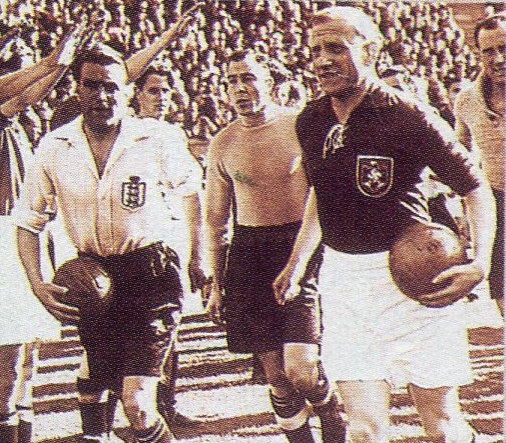

Photo From: Calcio 2000, Issue 31, June 2000
(Edris Hapgood leading out England, May 14, 1938, Germany 3-England 6)

3- War in Bosnia/Yugoslavia, 1992
Just weeks prior to the 1992 Euros in Sweden, Yugoslavia who had already qualified were excluded from the tournament on Political grounds.
This was due to the escalation of the war into Bosnia-Herzegovina.
Denmark, the runner-ups in their Group, were invited to take their place and ended up winning the Tournament.

Photo From: (Magazine Source unknown) / Contribution From a blog viewer
(Denmark’s victorious squad, June 26, 1992, European Championship, Denmark 2-Germany 0)


4- Jacques Chirac and Bolivia 1997
For Years Bolivia’s home venue of Estadio Hernándo Siles at La Paz has been criticized by visiting teams. Due to the fact that it is very high above sea level, makes it hard to breath especially for visiting teams who are not acclimatized to the local conditions. Many have suggested for that particular venue to be banned. For their part, the Bolivians have claimed that it is an advantage similar to some nations playing in hot weather or cold.
When 1998 World Cup hosts France’s President was in an official visit in Bolivia in 1997, he lent public support for Bolivia to maintain what it considers a home field advantage.


Photo From: Onze-Mondial, Issue 115, August 1998
(French President Jacques Chirac celegrating the World Cup win, July 12, 1998, World Cup, France 3-Brazil 0)

5- France and Italy Match 1938 World Cup
Italy and hosts France were to play one another during the Second Round of the 1938 World Cup in Paris (June 12, 1938, France 1-Italy 3).
Naturally, the Italians (under Benito Mussolini) expected a hostile reaction from the local fans, not to mention all the exiled Italians living in France.
Both teams wore Blue as their primary colors, it has been said lots were drawn to see who would wear blue and the French won. (Although perhaps as the host country, they already had that option).
The Italians could have worn their away strip of white, but it has been suggested that Mussolini himself wanted the Italians to wear their all Black jerseys to taunt the crowd and evoke memories of Fascist Black shirts.


Note: The Italians had already worn these black shirts weeks prior in a friendly (May 22, 1938, Italy 4-Yugoslavia 0)


Photo From: La Nazionale Italiana, 1978
(Italy squad, Top, left to right:  Aldo Olivieri ,  Michele Andreolo,  Ugo Locatelli , Alfredo Foni, Pietro Serantoni, Luigi ‘Gino’ Colaussi ,  Pietro Rava,  Amedeo Biavati ,  Giovanni Ferrari, Silvio Piola, Giuseppe Meazza  , June 12, 1938, World Cup, France 1-Italy 3)

New Addition: Politics and The Game, Part one

A new addition about social and Political events’ impact on the sport


1- The Falklands War and Osvaldo Ardiles
Argentina’s Osvaldo Ardiles was an idol for the fans at England’s Tottenham Hotspur fro many seasons. He had transfered there along with compatriot Ricardo Villa following the 1978 World Cup. He had been one of the rare foreign-born players to adapt to the British game.
The outbreak of the Falklands War in 1982 between his Nation and the United Kingdom forced him to leave England on patriotic grounds.
He was loaned to France’s Paris St. Germain at the start of the 1982/83 season.
In the middle of the season, with the political situation stable, he returned to Tottenham.

Photo From: Onze, Issue 81, September 1982
(Osvaldo Ardiles at Paris St. Germain, 1982/83)


2- Vittorio Pozzo at the 1938 World Cup
Pre-War Italy Manager Vittorio Pozzo used the politics of the day to his advantage to motivate his squad.
During the 1938 World Cup in France, he was well aware that many Italians that had fled Mussolini’s fascism had settled there.
Before Italy’s Opening match at Marseille vs. Norway on June 5, 1938 (Italy2 –Norway 1), he knew that some of the expatriate Italians in the Stadium would jeer the Italian national Anthem, specially the customary fascist salute.
He instructed his players to maintain their salute (their arms held up) until all the jeering and heckling had subsided. This way he believed he instilled in them patriotic fervor for the match.
It is unclear if he himself was a fascist, many observers do not believe so, though his methods and training regimen seemed dictatorial.


Photo From: La Nazionale Italiana, 1978
(Italy and Norway squads prior to the kick-off: June 5, 1938, World Cup, Italy 2-Norway 1)


Photo From: Azzurri, Storia della Nazionale di calcio tre volte campioni del Mondo, 1910-1983
(Vittorio Pozzo with the World Cup trophy,  June 19, 1938, World Cup, Italy 4-Hungary 2)


3- El Salvador and Honduras, Futbol War of 1969
It would be simplistic to say a Football match led to an all out war between two neighboring nations. One would have to extensively study the history of the nations and all the social and political events that led to it.
Following two World Cup qualifiers that each home nation won, a play-off in neutral Mexico City, on June 26, 1969,  was to decide who would qualify for the World Cup.
El Salvador won the match (3-2) and on the same day cut off all diplomatic ties with Honduras.
On July 14, 1969, the El Salvador Air Force started bombing Honduras.  On July 18th, the Organization of American States negotiated a cease-fire to end the conflict.


4- USSR and Chile, World Cup Qualifier, 1973
On November 21, 1973, Chile were to host USSR in a World Cup Qualifying playoff in Santiago’s Estadio Nacional.
The first leg in Moscow on September 26th had resulted in a scoreless tie.
On August 11, 1973, General Augusto Pinochet had assumed control of Chile following a Military Coup.
The Soviets refused to play Chile in that Stadium. They claimed that Pinochet’s regime had tortured and executed left leaning political prisoners in that same stadium following the Coup.
The match was forfeited and Chile qualified for the World Cup.
Chile was present at the field on matchday and scored after a mock kick-off.
Incidentally right after the farce ‘match’, Chile played a Friendly vs. Brazil’s Santos and lost 0-5.

Photo From: World Soccer, March 1974
(Chilean players during the mock kick-off, November 21, 1973)


5- Billy Bingham
Following the 1986 World Cup, Northern Ireland Manager was employed as a Manager in Saudi Arabia with Al Nassr.
He was still the Northern Ireland National Team manager, in addition to his management duties with Al Nassr.
On February 18, 1987, Northern Ireland were due to play a Friendly vs. Israel at Tel Aviv (1-1 tie.)
Due to obvious political reasons, he diplomatically did not manage Northern Ireland for that match. James Archibald Platt stood in for him.


Photo From: World Soccer, June 1993
(Billy Bingham)